Pacific women making waves for climate justice
28 December 2025Pacific leadership was on full display when allies from across the region drove a historic case at the International Court of Justice, resulting in a landmark Advisory Opinion affirming states’ legal obligations to prevent climate harm and protect human rights.
In April 2023, the United Nations General Assembly passed a historic resolution requesting an Advisory Opinion (AO) from the International Court of Justice (ICJ) on states’ climate obligations – a pivotal moment for Pacific Islands Countries and Territories (PICTs) fighting for survival, justice and future generations.
The Government of Vanuatu and Pacific Islands Students Fighting Climate Change (PISFCC) had long championed this call. Over two years, it became a coordinated Pacific-wide effort. Governments, CROP agencies, CSOs, faith leaders, feminist organisations and youth movements came together to frame climate change as a human rights issue. They prepared evidence-backed statements, gathered community testimonials, and launched advocacy campaigned that reached national, regional and global platforms.
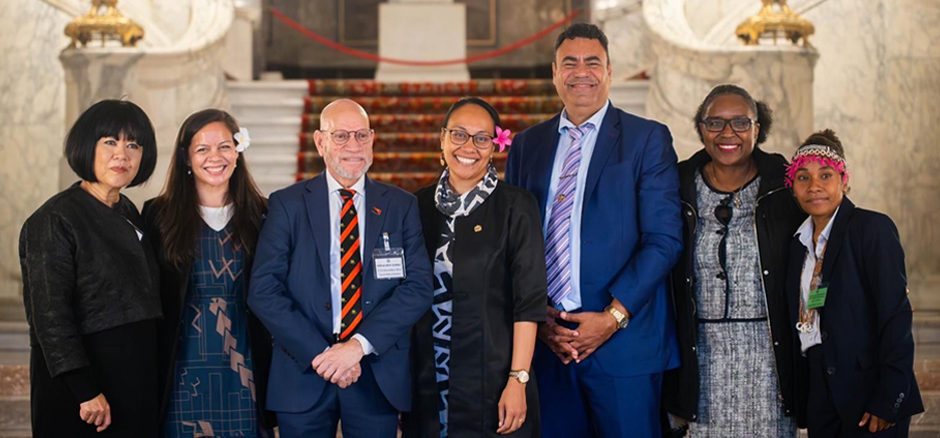
Pacific women were at the forefront – leading delegations, authoring legal submissions and amplifying experiences in public forums. Young women contributed to fresh perspectives and urgency, ensuring the case for climate justice reflected both legal argument and the realities of Pacific communities. Through this collective effort, the region built a compelling and united call for action the world could not ignore.
When the oral hearings convened at The Hague in December 2024, the Pacific presence was undeniable. Of the fourteen PICTs, eleven submitted written statements, and thirteen delivered oral arguments. Gender equality was central: five written statements addressed the climate change impacts on women, over half included gender analyses, and three explicitly referenced gender equality and intersectional discrimination.
Women also led the charge in representation. Seven out of the thirteen Pacific delegations had women presenting their country statements, and three had all-female delegations. One submission incorporated women’s voices through video testimony, ensuring their lived experiences were centred.
Cynthia Houniuhi, President of PISFCC, delivered a powerful address in her native language, linking her words to her ancestors and future generations. Her message was clear:
“It is upon our land that our values and principles are rooted, preserved and transmitted across generations. Those who stand to lose are the future generations. Their future is uncertain. Reliant upon the decision making of a handful of large emitting states that are responsible for climate change.”
For Pacific women, climate justice is not abstract – it is lived reality. Women sustain communities, culture, and food security while disproportionately bearing climate-induced displacement and resource scarcity. By speaking at the ICJ, Pacific women were not only advocating for legal recognition but reclaiming power in spaces where their voices have historically been marginalised.
The outcomes of the ICJAO were delivered on 23 July 2025 – affirming that states have binding legal obligations under treaties such as UNFCCC, Kyoto Protocol, Paris Agreement and customary international law to prevent climate related harm, protect present and future generations, provide remedies and reparations for damage and uphold corporate accountability under international law. The legal commentary underscores that this opinion embeds climate justice as a binding legal obligation, including sectors across treaties, human rights, trade, loss and damage and fossil fuel phase-outs.
With the ICJ reinforcing states’ obligations to prevent climate harm and protect human rights, such measures can translate to:
- stronger legal backing for women-led disaster response and resilience programs;
- increased climate finance and reparations directed to gender-sensitive initiatives;
- enhanced accountability of states and private actors to integrate gender equality into adaptation and mitigation strategies; and
- greater recognition of intersectional vulnerabilities, including disability and gender dimensions.
The ICJ proceedings and outcome marked a turning point in global climate governance and a pivotal legal milestone. Pacific female leadership is reshaping the climate justice narrative, forcing global actors to confront an uncomfortable truth: today’s decisions will determine the fate of future generations. Through their words, presence, and determination, Pacific women are proving that climate justice is a fight for humanity – and they are leading it.