Ensuring sexual reproductive health access for all: A focus on disability
27 December 2025In Fiji, a groundbreaking initiative is breaking down barriers to sexual and reproductive health by putting people with disability at the heart of the conversation. Through a powerful partnership of health providers, disability advocates, and government agencies, the program is making vital services more inclusive, accessible, and empowering for all.
For too long, people with disability have been invisible in – and excluded from – conversations around sexual and reproductive health and rights (SRHR). Stigma, inaccessibility, and silence have kept vital information and services out of reach. But in Fiji, that narrative is changing.
Since 2022, the Community-Based Sexual and Reproductive Health Officers programme has been making significant strides in ensuring SRHR and Gender-Based Violence (GBV) services are inclusive and accessible to persons with disability. Led by a multi-stakeholder partnership that includes the Ministry of Health and Medical Services (MHMS), the Ministry of Women, Children, and Social Protection (MWCSP), the Fiji Disabled Persons Federation (FDPF), the Pacific Disability Forum, Medical Services Pacific and UNFPA’s flagship programme, Transformative Agenda for Women, Adolescents and Youth, the initiative is reshaping public health outreach.
A key driver of the program’s success is the active involvement of persons with disability as co-facilitators of outreach activities, along with SRHR service providers working for MHMS and MSP. In contexts where SRHR is still highly taboo, women and young people with disability feel more comfortable discussing these issues with other people with disability who are experts on disability rights and the lived experiences of people with disability in exercising these rights.
The transformative impact of this innovation came into sharp focus in Nasinu, where the Nadawa Church Hall became a safe space for open, respectful dialogue in June 2025. For many, it was the first time speaking directly with health professionals. As one participant, Josefa, shared: “Earlier, my source of information for my sexual health was mainly the media. This is the first time I’ve had a one-on-one session with health professionals who answered all my questions.”
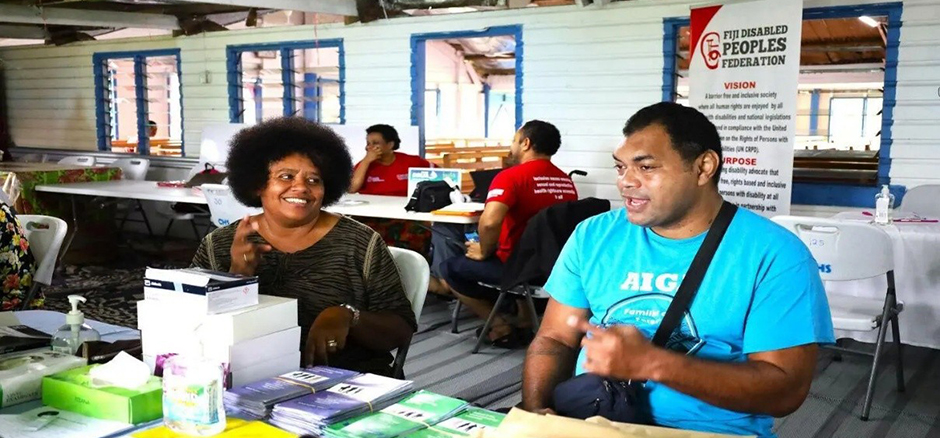
The impact is tangible. In the last four years, more than 750 women and young people with and without disability have attended the outreach activities conducted as part of the programme and accessed SRHR information and services, most of them –as reported by Josefa– for the first time in their lifetime.
The programme includes strategic actions to progressively increase the availability of fully accessible and disability-inclusive services to meet increased demand, including ongoing capacity strengthening for service providers and SRH officers. In July 2024, two capacity-building workshops brought together disability advocates, health providers, and government representatives. The first workshop equipped 34 participants with rights-based approaches to SRHR and GBV response. The second focused on lessons learned and future planning, engaging 12 health service providers.
To ensure the sustainability of the programme– and as a testament to its success–, the Ministry of Health awarded FDPF a competitive grant of 150,000 FJD to continue disability-inclusive outreach in 2025. Leaders like Anaseini Vakaidia, SRH Project Coordinator at FDPF, have been instrumental in ensuring no one is left behind. “Our role was to reach out, mobilize, and ensure persons with disability were not forgotten in this space.” Says Anaseini.