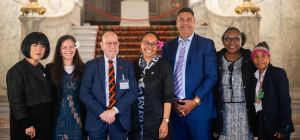
Equality in practice, from maternity to paternity leave in Kosrae
27 December 2025In Kosrae, the Utwe Women Organisation has turned maternity leave reform into a broader movement for gender equality by championing the introduction of paid paternity leave for fathers. Backed by Pacific Women Lead, their grassroots advocacy demonstrates how locally driven action can shift policies, challenge gender norms, and embed gender mainstreaming in Pacific workplaces and communities.
When Kosrae passed a landmark law granting 12 weeks of paid maternity leave for female state government employees in 2022, it marked a turning point for workplace gender equality in the Federated States of Micronesia. But for the Utwe Women Organisation (UWO), it was also just the beginning.
“There cannot be equality at home when only one parent is given the time to care.” – Krystle Melander, Project Manager at UWO
With support from the Pacific People Advancing Change (PPAC) programme, and funding through the Pacific Women Lead (PWL) programme at SPC, UWO set out to address a critical gap: the absence of paternity leave for fathers in Kosrae’s public sector.
Their message was simple but bold: Paternity leave is of equal importance to maternity leave.
Under Kosrae’s amended maternity leave law, women working for the state government regardless of contract type were entitled to three months of paid maternity leave.
However, no such provision existed for fathers. The result? Women shouldered the early months of caregiving alone, often while navigating recovery and household responsibilities, while their partners returned to work immediately.
UWO’s proposal highlighted the consequences of weakened early bonding between father and child, reinforced gendered caregiving roles, and missed opportunities to strengthen family relationships. Their solution was clear; to introduce a bill that grants paid paternity leave for male state employees to bridge that gap.
Supported by PPAC’s training and mentoring, UWO designed an advocacy strategy grounded in community engagement. They conducted leadership workshops, mobilised youth groups, and trained men in advocacy skills. These were not just one-off token consultations; they were intergenerational dialogues that built trust, surfaced real-life stories, and amplified public support for the proposed paternity leave bill.
Despite a full 2024 calendar, UWO advanced its mission. Formal legislative sessions were delayed, but UWO members met individually with state senators to present the draft paternity leave bill, share community feedback, and secure support.
Simultaneously, UWO trained Utwe Youth Group members in video documentation to capture community perspectives. Videos featured fathers, traditional leaders, and youth emphasising that paternity leave is a shared responsibility. One participant noted, “When fathers take leave, it is not just about rest. It is about bonding, caregiving, and saying that both parents’ matter.”
By June 2024, the draft bill was introduced to the Kosrae State Legislature with support from 11 senators – enough for passage. Over 40 men participated in UWO workshops, doubling the initial target and highlighting grassroots engagement with gender equity and caregiving.
This progress reflects Kosrae’s commitment to gender-responsive policy, and the initiative builds on the success of Kosrae’s maternity leave law, demonstrating the impact of locally driven, inclusive policy reform.