From data to dialogue: Using stories to deepen learning
23 February 2026By Iris Low (Co-Director, CoLAB) and Kaisha Crupi (MEL Manager, Pacific Women Lead at SPC)
Impact stories have long been an important part of monitoring, evaluation and learning (MEL) at Pacific Women Lead, but at the most recent Annual Reflection and Analysis Workshop they took centre stage. Instead of being embedded within broader analysis discussions, impact stories were given their own dedicated session. This shift wasn’t just a logistical change – it fundamentally altered how participants engaged with evidence and learning.
Why stories matter
Unlike statistics, stories carry nuance, context and emotion. They give voice to experiences that might otherwise remain unspoken. They also surface insights that can inform future programming in ways that quantitative data alone often cannot.
From a MEL perspective, impact stories serve as a window into real-world changes resulting from activities on the ground. They demonstrate the depth of the work by showing how partnerships translate into tangible outcomes, amplify diverse voices, and contribute to gender equality and social inclusion.
“What’s special about this workshop for me is because it has this Pacific-centred voice… The sharing of stories complements the reporting. It’s not just looking at the data or ticking the box. It’s looking at the context, at the story of why the data is looking that way.”
– Tauyavu Tuvanua, Tonga Australia Support Platform
Process and preparation
Capturing and finalising impact stories requires significant preparation. For the most recent workshop, it took around 9 months from start to finish – from identifying potential examples of change to preparing stories for the workshop. We started by reaching out to a wide range of partners across the portfolio to identify examples of change or impact, whether through policy shifts, community empowerment, or innovative approaches to gender equality.
We then shifted our focus to writing them up. In some cases, this was done by PWL partners themselves. In others, we worked collaboratively to produce a total of 54 impact stories, 25 of which were showcased at the 2025 workshop. Stories not featured in the session were integrated into results charts, to ensure that every contribution was captured in the program’s narrative.
Reflection and celebration
At the workshop, we introduced the stories using the Most Significant Change (MSC) process – a participatory storytelling approach that invites people to reflect on what meaningful change really looks like and why it matters.
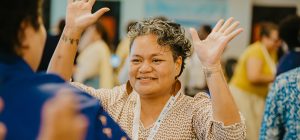
Participants read the stories and worked in small groups to discuss the changes and values they felt were most significant. They then convened in larger groups to reach consensus on the most significant story for each sub-outcome area to report back to the plenary. This new format proved highly successful. Report-backs were often creative, with groups using role play, dance and other participatory methods to present their chosen stories.
The session turned out to be an absolute highlight of the workshop, not just because it was engaging, but because it deepened collective reflection on what impact actually looks like across contexts. We met afterwards as a core facilitation team to reflect on the approach and agreed that it should be continued in future workshops. We also agreed that the MSC process at the workshop was never really about choosing one story. It was about using stories as a tool for learning, reflection and dialogue.
“Listening to the stories and lessons of our sister countries in the Pacific feels like weaving together our voices into a shared journey… The passion in the room reignited a spark inside me. It’s a reminder of why this work really matters.”
– Summer Rros Saunders, Palau National Olympic Committee
The exercise helped participants explore what change looks like in different contexts, recognise diverse forms of impact, and reflect on the shared values that drive the Pacific Women Lead portfolio forward.
You can read all the impact stories from the 2025 Annual Reflection and Analysis Workshop on the Pacific Women Lead website.