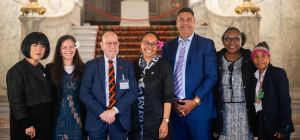
Pacific voices at the centre: A turning point for CEDAW
27 December 2025The April 2025 Pacific Technical Cooperation Session on CEDAW transformed a previously distant UN process into a Pacific-led, Pacific-owned milestone, bringing the full CEDAW Committee to Fiji for the first time. With over 1,000 participants, strong youth leadership, and region-wide collaboration, the event set a powerful precedent for how Pacific voices can shape global human rights mechanisms on their own terms.
The Pacific Technical Cooperation Session on CEDAW, held in Fiji in April 2025, marked a profound turning point in how global human rights mechanisms connect with the Pacific. For the first time ever, the full CEDAW Committee convened outside Geneva. This was a move that transformed CEDAW from a distant reporting obligation into a lived, Pacific-owned process. Instead of sending small delegations abroad, Pacific countries were able to reinvest funds into broader, more inclusive in-region participation with more than 1,000 people joining in person and online, including youth, CSOs, people with disabilities and government representatives to engage directly with the global CEDAW Committee on their own terms. Although only three Pacific countries were providing their reporting to the CEDAW Committee (Fiji, Tuvalu and Solomon Islands), there was engagement and attendance from 15 Pacific Island countries and territories*, whether they are ratified in CEDAW or not, to learn from the process.
Born out of years of regional advocacy, and modelled on earlier efforts such as the Convention of the Rights of the Child (CRC) Session in Samoa in 2020, the event went beyond technical reporting. Co-convened by SPC, PIFS and OHCHR, the Session included side events, talanoa, and practitioner-led dialogues to immerse Committee members in the cultural, political, and logistical realities of Pacific life, deepening what CEDAW Chair Ms. Nahla Haider called an understanding of “the contexts, constraints, and aspirations… [that was] tremendously beneficial for the Committee.”
Perhaps the most significant shift was the elevation of adolescent girls from observers to agenda-setters. One of the talanoa sessions on Children, Youth and Gender opened with Pacific Sista Tok, a powerful video featured voices of girls from across the region, with some of those voices included in the talanoa. For many it was the first time they were not simply present, but leading formal engagement with a UN treaty body. Their voices were central, not peripheral – challenging traditional power structures and proving that meaningful youth participation is both possible and impactful.
“CEDAW is a call to action. But for it to be impactful, it can’t just exist as a set of principles on paper. We need to make it tangible, something experienced by young people every day in our villages, communities, towns, and cities.” – Melissa Bule, Pacific Youth Council
As a result of the Children, Youth and Gender talanoa, one of the Committee members, Natasha Stott Despoja broached the subject on having a Special Rapporteur for the Girl Child as part of the CEDAW Committee, as well as encouraging the CEDAW Committee to work closely with the CRC in the delivery of their respective mandates.
In the preliminary report and vote of thanks, the attending Pacific Island Countries acknowledged “the leadership shown by the three countries under review…opening themselves up to scrutiny not only by the CEDAW Committee but also by the other Pacific Islands Countries and in doing so demonstrated a commendable level of accountability.”
By making CEDAW look, feel and sound Pacific, this Session seeded a new model for how the region engages with global human rights systems – not as distant observers, but as active, equal partners shaping the agenda from the ground up.
*Attendance from Australia, Cook Islands, Federated States of Micronesia, Kiribati, Nauru, Republic of the Marshall Islands, New Zealand, Niue, Papua New Guinea, Samoa, Tonga, Vanuatu.